
Fiber Optics and Modern Communications Backbones
- [Columbia University]
- Overview
Fiber optics form the essential backbone of modern communications by using light pulses in glass fibers to transmit massive amounts of data at high speeds over long distances, powering the internet, cloud computing, 5G networks, and global telecommunications with unmatched bandwidth, reliability, and low latency, replacing copper for critical infrastructure due to superior performance and immunity to interference.
1. Key Roles in Modern Networks:
- Global Internet & Data Centers: Transports internet traffic, streaming services, and cloud data between continents and major hubs.
- 5G & Next-Gen Wireless: Provides the high-capacity backhaul needed for dense 5G cell towers and advanced wireless applications.
- Enterprise & Government: Connects corporate offices, government sites, and military networks, ensuring secure, fast data sharing.
- Healthcare: Supports telemedicine, large digital records, and real-time diagnostics.
- Smart Cities: Manages traffic, surveillance, and IoT devices with high-speed infrastructure.
2. Why Fiber Optics Are Superior:
- High Bandwidth: Carries significantly more data than copper cables.
- Low Latency: Enables near-instantaneous data transfer, vital for real-time apps.
- Long Distance: Transmits signals over vast distances with minimal loss (attenuation).
- EMI Immunity: Unaffected by electromagnetic interference, ensuring reliable data.
- Security: More difficult to tap without detection than copper lines.
3. How It Works:
- Total Internal Reflection: Digital data is converted to light, which bounces down a glass core, reflecting off a surrounding cladding layer.
- Core & Cladding: A core with a higher refractive index is surrounded by cladding with a lower one, trapping the light.
- Types: Single-mode (long-haul, single light path) and multimode (shorter distances, multiple paths).
4. Backbone Definition:
A fiber backbone connects major network points (buildings, data centers, cities), aggregating data from smaller links, forming the foundational, high-capacity network that carries virtually all data.
- Fiber Optics and The Backbone of High-speed Internet
Fiber optics form the backbone of high-speed Internet, providing the necessary infrastructure for the fast and efficient transmission of data across the global network.
Fiber optics are considered the "backbone" of modern communication systems, as they utilize light signals transmitted through optical fibers to carry vast amounts of data at extremely high speeds over long distances, making them the primary technology used in building high-speed telecommunications networks across the globe, including internet access, phone lines, and data centers.
Essentially enabling the rapid transfer of information with minimal signal degradation compared to traditional copper wires.
Impact on modern communications:
- Enhanced internet connectivity: Fiber optic technology is the foundation for high-speed internet access, enabling streaming services, online gaming, and large data transfers.
- Improved telecommunications: Reliable and fast transmission of phone calls over long distances.
- Data center efficiency: High-speed data transfer between data centers, critical for cloud computing and large-scale data processing.
Key characteristics about fiber optics and modern communication backbones:
- High Bandwidth: Fiber optic cables can transmit significantly more data than copper wires, allowing for faster internet speeds and the ability to handle large volumes of information simultaneously.
- Reliability: Due to the nature of light transmission, signal degradation is minimal over long distances, ensuring reliable data transfer.
- Wide Applicability: Fiber optics are used in various communication applications, including long-haul network connections, undersea cables for international communication, data center interconnections, and even local area networks.
How fiber optics works:
- Light pulses: Data is converted into light pulses which travel through the fiber optic cable's core.
- Total Internal Reflection: The light is kept within the core by a cladding layer with a lower refractive index, ensuring efficient transmission.
- Transceivers: Devices called transceivers convert electrical signals into light pulses at the sending end and back again at the receiving end.
- The Building Blocks of the Optical Communication System
The building blocks of an optical communication system include an optical transmitter (converts electrical to light signals), an optical fiber cable (the transparent channel for light), amplifiers (boost signals over distance), and an optical receiver (converts light back to electrical signals), all working to send digital data as light pulses for high-speed, high-bandwidth communication.
1. Key Components:
- Optical Transmitter: Takes electrical signals (from computers, phones) and uses a laser or LED to turn them into pulses of light.
- Optical Fiber Cable: Ultra-thin strands of glass or plastic that carry these light pulses over long distances.
- Amplifiers: Devices placed along the fiber to boost the light signal, preventing degradation over long hauls.
- Optical Receiver: Detects the light pulses at the destination and converts them back into electrical signals.
- Light Signal: The actual data carrier, transmitted as pulses of light.
2. How it Works:
- Conversion: An electrical signal from a device (like a computer) is fed into the transmitter.
- Encoding: The transmitter converts this electrical data into pulses of light.
- Transmission: The light pulses travel through the optical fiber cable.
- Amplification: Along the way, amplifiers strengthen the light signal.
- Decoding: The receiver at the end detects the light pulses and turns them back into usable electrical signals.
- (Dr. Charles Kao at work in his laboratory at Harlow, England in 1966.)
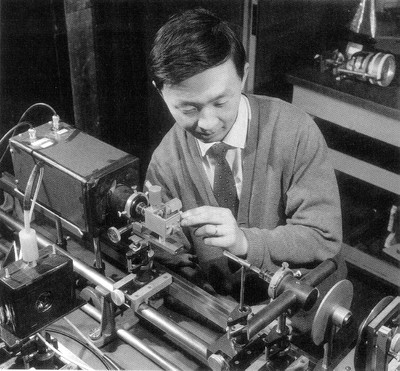
- Dr. Charles Kuen Kao - The Father of Fiber Optic Communications
Dr. Charles Kuen Kao is known as the "father of fiber optic communications" for demonstrating in the 1960s that highly purified glass fibers could transmit light signals with minimal loss, a breakthrough enabling high-speed data transmission, for which he shared the 2009 Nobel Prize in Physics. His work showed that purifying glass to reduce signal attenuation, which was previously thought impossible due to scattering, was the key to long-distance optical communication, paving the way for the internet.
- Key Breakthrough: Realizing that ultra-pure glass could significantly reduce signal loss (attenuation), making long-distance data transmission feasible.
- Nobel Prize: He shared the 2009 Nobel Prize in Physics for this work.
- Impact: His research laid the foundation for modern telecommunications, including the internet, by making broadband communications possible.
- Prior Belief: Glass fibers were previously seen as poor conductors due to high signal loss from light scattering, making them unsuitable for communication.
- The Key Advantages of Optical Fiber
Optical fiber's advantages include massive bandwidth, faster speeds, longer distances, immunity to electromagnetic interference (EMI), better security, lighter weight, and lower overall maintenance due to fewer repeaters, making it superior for high-speed data, voice, and video, replacing copper in modern communication backbones.
These benefits have made fiber the preferred medium for global telecommunications, internet, and cable TV, enabling today's digital world by providing the essential backbone for data transport.
Key Advantages:
- High Bandwidth & Speed: Transmits more data faster, supporting high-speed internet and heavy usage.
- Longer Distance: Signals travel farther with less degradation, requiring fewer repeaters.
- EMI Immunity: Unaffected by electrical noise, ensuring clearer signals in industrial settings.
- Improved Security: Doesn't emit signals that can be easily intercepted.
- Lighter & Smaller: Easier to install and use in applications like aircraft and vehicles.
- Lower Maintenance: Fewer components and less power needed over time.
- Fiber Optic Backbone
Fiber optics form the essential "backbone" of the internet, using light signals through thin glass strands to transmit massive amounts of data at incredible speeds over long distances, connecting continents, countries, and major data centers, enabling everything from streaming to cloud computing by replacing slower copper cables with high-capacity, interference-resistant links.
This global network of fiber cables, including vast undersea ones, carries the core internet traffic, linking major routers and ISPs to deliver fast, reliable connectivity worldwide.
1. How Fiber Optics Power the Internet Backbone:
- Speed & Bandwidth: Light travels faster and carries far more data than electrical signals over copper, providing the massive bandwidth needed for modern internet use.
- Long-Distance Transmission: Fiber minimizes signal loss (attenuation), allowing data to travel thousands of miles (like transatlantic cables) with fewer signal boosters (repeaters).
- Reliability: Fiber isn't affected by electromagnetic interference (EMI), ensuring cleaner, more stable data transmission compared to copper, reducing noise and errors.
- Scalability: A single fiber cable can carry multiple services (internet, video, voice) and can be upgraded by using more fibers within the same cable for future needs.
2. Key Components & Functions:
- Long-Haul Backbones: Connect major cities and continents.
- Metro Backbones: Link areas within a city or region.
- Undersea Cables: The crucial links connecting continents across oceans.
- Data Centers & ISPs: Rely on these backbones for high-speed connections to move data between servers and users.
3. Impact on Users:
- Enables high-definition video streaming, cloud gaming, and remote work.
- Provides the consistent, high-speed data flow essential for the digital economy and smart cities.
- Connects the "last mile" to homes and businesses, forming the foundation for all online activities.
<More to come ..>
