
Nuclear Energy
- (The Diablo Canyon Nuclear Power Plant - The Nuclear Regulatory Commission, U.S.A.)
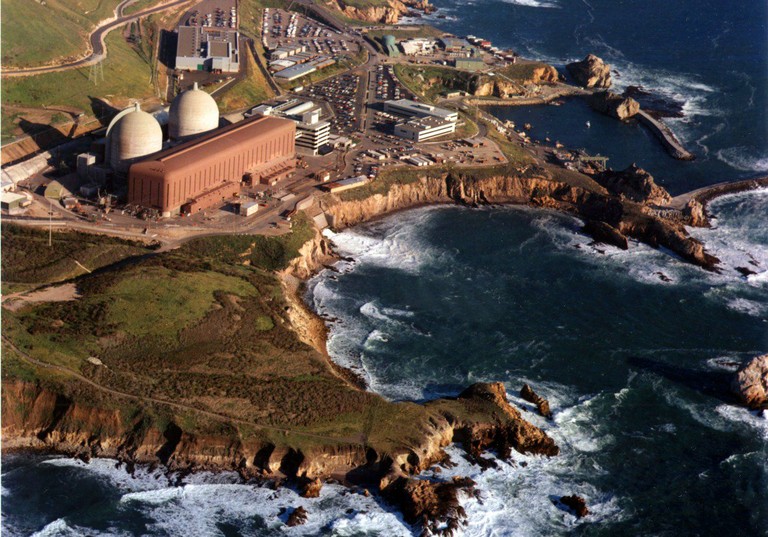
- Overview
Nuclear energy is the energy held in the nucleus (core) of an atom, released by breaking those bonds through nuclear fission (splitting atoms) or combining them through fusion.
Primarily generated via fission in power plants, it produces vast amounts of heat to create steam and electricity without directly emitting greenhouse gases, providing a carbon-free, high-density energy source.
Nuclear energy provides about 10% of the world's electricity and around 20% in the United States.
1. Key Aspects of Nuclear Energy:
- How it Works (Fission): In a reactor, neutrons collide with atoms (usually Uranium-235), causing them to split and release a massive amount of heat and more neutrons, creating a chain reaction.
- Electricity Generation: This heat boils water to produce steam, which spins turbines connected to generators to produce electricity.
- Carbon-Free: Nuclear energy is considered a clean, zero-emission source, as it does not burn fossil fuels, contributing to climate goals.
- Energy Density: Nuclear fuel is millions of times more energy-dense than fossil fuels, meaning a tiny amount of fuel produces a massive amount of energy.
- Regulation: Power plants are heavily regulated (e.g., by the Nuclear Regulatory Commission (NRC)) for safety.
2. Key Differences:
- Fission: Splitting large atoms (current technology for electricity).
- Fusion: Combining small atoms, a cleaner process that is still in the research and development phase.
- Nuclear Power in the World
Nuclear power plays a critical role in clean energy transitions by providing reliable, low-carbon baseload electricity, accounting for roughly 10% of global generation (nearly 20% in advanced economies as of 2023).
With over 400 reactors in 30+ countries, it offers significant decarbonization potential, operating with minimal land impact.
To achieve net-zero, global nuclear capacity needs to grow by about 15 GW per year through 2030.
1. Key Aspects of Nuclear Energy's Role:
- Decarbonization & Clean Energy: Nuclear power is a major source of carbon-free electricity, helping to reduce greenhouse gases while providing a stable, 24/7 power supply, often referred to as base-load power.
- Reliability: Nuclear plants have the highest capacity factor of any energy source, running at full power over 92% of the time, roughly twice as reliable as coal or natural gas and three times more than wind or solar.
- Environmental Impact: It has the smallest footprint regarding land use and natural resources compared to other energy sources.
- Global Capacity: More than 400 commercial reactors are operational worldwide. While some countries face challenges, the International Energy Agency (IEA) suggests nuclear capacity must expand to meet net-zero goals.
2. Operational Mechanism:
- Fission Process: Nuclear reactors produce heat by splitting atoms (fission) in a controlled chain reaction.
- Steam Generation: This heat boils water to produce steam, which spins turbines to generate electricity.
- Fuel Source: The process primarily uses processed uranium as fuel.
3. Challenges and Future Outlook:
- Challenges: Despite its benefits, the industry faces challenges in certain regions, including high capital costs, long construction times, and safety/waste management concerns.
- Future Potential: The sector is advancing with new, safer, and more efficient advanced reactor technologies.
- Nuclear Fusion vs. Nuclear Fission
Nuclear fission splits heavy atoms (e.g., Uranium) into lighter ones, releasing significant energy used in power plants and atomic bombs.
Conversely, nuclear fusion combines light atoms (e.g., Hydrogen) into heavier ones, producing 3–5 times more energy. Fusion powers stars, while fission requires far less energy to initiate.
Key Differences Between Nuclear Fission and Fusion:
- Process: Nuclear Fission splits a heavy nucleus into smaller nuclei, whereas Nuclear Fusion merges light nuclei to form a heavier nucleus.
- Energy Release: Fusion releases much more energy than fission (3-5 times more).
- Natural Occurrence: Fission is generally artificial (often in reactors), while fusion occurs naturally in stars and the sun.
- Energy Required: Fission requires relatively little energy to split an atom, but fusion requires extremely high energy (temperatures/pressure) to initiate.
- Applications: Fission is used in nuclear power plants and atomic bombs; Fusion is used in hydrogen bombs and is being researched for sustainable energy.
- Waste: Fission produces radioactive waste, while fusion produces little to no long-lived radioactive waste.
2. Fundamental Similarities:
Both processes involve the binding or breaking of elemental nuclei, releasing tremendous amounts of energy (often described by e = mc2).
Both result in a "mass defect," where the final product's mass is less than the sum of the initial mass, with the missing mass converted into energy.
- Clean Source of Power
Nuclear energy provides nearly 20% of U.S. electricity, acting as the largest source (over 55%) of carbon-free power. It is highly reliable, operating 24/7 with a 93% capacity factor.
As a low-carbon energy source developed in the 1950s, it is crucial for addressing climate change and mitigating fossil fuel price volatility.
1. Key Aspects of Nuclear Energy as a Clean Source:
- Carbon-Free Generation: Nuclear power plants do not emit greenhouse gases, protecting air quality by avoiding pollutants like sulfur dioxide and nitrogen oxide.
- Major U.S. Clean Energy Source: Nuclear provides more than half of the nation's carbon-free electricity, with 94 reactors generating enough power for 75 million homes.
- High Reliability: Nuclear plants operate at full capacity more than 93% of the time, which is 1.5 to 3.5 times more reliable than wind, solar, coal, or natural gas.
- Efficiency: One small uranium fuel pellet produces as much energy as a ton of coal.
- Global Role: It is the world's second-largest source of low-carbon electricity, behind hydropower.
2. Development and Future:
- History: Developed in the 1940s for defense, focus shifted to peaceful, controlled fission for power in the 1950s.
- Current Outlook: Despite some closures, federal policies are supporting the existing fleet and the development of new advanced reactors to meet rising demand for clean electricity.
- Environmental Impact: Nuclear power saves the atmosphere from over 470 million metric tons of CO2 emissions annually.
- The Major Challenges of Nuclear Energy
Nuclear power faces significant hurdles in becoming a primary global energy source, ranging from technical safety to long-term environmental and political concerns.
1. Core Challenges:
- Safety and Resilience: Ensuring plants can withstand natural disasters (e.g., earthquakes, floods) and external aggression (terrorism or military conflict) remains a top priority.
- Waste Management: Developing permanent, effective solutions for long-term radioactive waste and spent fuel disposal is a critical, unresolved environmental issue.
- Economic Competitiveness: High capital costs, long construction times, and complex licensing processes often make nuclear projects less attractive than other energy sources.
- Public Confidence: Overcoming deep-seated public mistrust fueled by past disasters like Chernobyl and Fukushima is essential for expanding nuclear capacity.
- Security and Non-Proliferation: Preventing the diversion of nuclear technology or materials for weapons production is a major international security challenge.
- Workforce Development: Building and maintaining a skilled workforce to design, operate, and regulate modern nuclear facilities is necessary for industry growth.
2. Current Global Status:
- Operational Count: There are currently 416 to 439 operational nuclear reactors worldwide, depending on the most recent tracking data.
- Global Output: Nuclear energy accounts for approximately 9–10% of total global power generation (a decline from the 14% mentioned in older reports).
- Growth Projections: The IAEA expects capacity to rise significantly, with over 20 countries recently pledging to triple nuclear production by 2050 to meet net-zero goals.
- The Nuclear Fuel Cycle
The nuclear fuel cycle comprises industrial processes - mining, milling, conversion, enrichment, and fabrication ("front end") - to create uranium fuel for electricity generation. After ~3–6 years of reactor use, spent fuel enters the "back end" (storage, reprocessing, or disposal).
- (The Nuclear Fuel Cycle - World Nuclear Association)
This cycle optimizes uranium usage and manages waste.
(A) Key Stages of the Nuclear Fuel Cycle:
1. Front End (Preparation):
- Mining & Milling: Uranium ore is extracted and processed into yellowcake (U3O8).
- Conversion: Yellowcake is converted into uranium hexafluoride (UF6) gas.
- Enrichment: Increases the U235 isotope concentration to 3%–5% for reactor use.
- Fabrication: UF6 is converted into fuel pellets and assembled into rods.
2. Energy Generation: Fuel generates electricity for 3–6 years.
3. Back End (Management):
- Interim Storage: Spent fuel is cooled in water pools or dry casks.
- Reprocessing/Recycling: Recovers usable uranium and plutonium from spent fuel.
- Disposal: Permanent, deep geological storage of high-level waste.
- Cycle Sustainability: Reprocessing allows most spent fuel to be recycled, turning a linear process into a cycle.
- Energy Density: One kilogram of uranium produces 10,000 times more energy than an equivalent amount of coal.
- Safety: Used fuel is highly radioactive and requires specialized handling and long-term, deep geological storage solutions.
- Nuclear Waste Storage
Nuclear waste storage involves safely containing radioactive byproducts from power generation, medicine, and defense using multi-stage methods to prevent environmental contamination.
High-level waste (spent fuel) is stored for 5 years in water-filled pools, then moved to dry casks. Low-level waste is typically stored in specialized, secure underground facilities.
(A) Key Aspects of Nuclear Waste Storage:
1. Temporary Storage (Wet and Dry):
- Spent Fuel Pools: Immediately after removal from a reactor, fuel rods are placed in steel-lined, 40-foot deep water pools to cool down and shield radiation.
- Dry Cask Storage: After cooling (typically $\sim$5+ years), waste is moved to concrete and steel containers designed to last for decades.
2. Long-Term Disposal:
- Deep Geological Disposal: The widely accepted, yet often unimplemented, solution for high-level, long-lived waste is isolating it deep underground in stable geological formations.
- Vitrification: Radioactive liquid waste from defense operations is mixed with glass, heated, and solidified in steel canisters for safer storage.
3. Waste Classification:
- High-Level Waste (HLW): Spent fuel that remains radioactive for thousands of years.
- Low-Level Waste (LLW): Contaminated materials like tools and protective clothing with shorter-lived radioactivity.
(B) Current Status in the U.S.:
Most commercial waste remains in temporary, on-site storage at nuclear plants because a permanent, nationwide repository (like the stalled Yucca Mountain project) has not been fully implemented. Interim storage facilities are being considered, but legal challenges often arise.
[More to come ...]
