
5G and Beyond Millimeter Wave Spectrum
- (Millimeter Wave Spectrum - National Instruments)
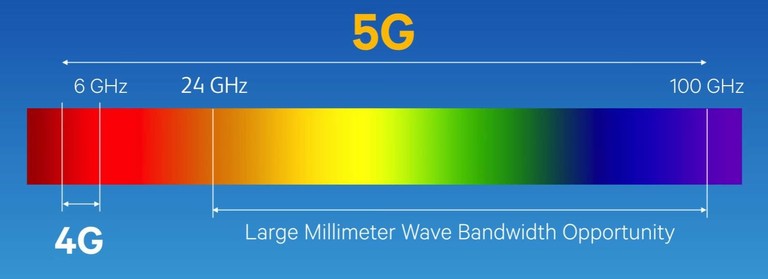
Extremely High Frequency Means Extremely Fast 5G Speeds
- Overview
5G utilizes Millimeter Wave (mmWave) spectrum (24-100 GHz) for ultra-fast, high-capacity data, enabling applications like enhanced AR/VR and smart cities, but suffers from short range and poor penetration, requiring many small cells.
Future generations (6G and beyond) build on this by exploring even higher frequencies (above 95 GHz) for massive capacity, sensing, and even more immersive experiences, balancing mmWave's speed with lower frequencies for broader coverage, using massive MIMO and beamforming to overcome propagation challenges.
1. 5G Millimeter Wave (mmWave):
- Frequencies: Generally 24 GHz to 100 GHz, with specific bands allocated like 24, 28, 37, 39 GHz.
- Pros: Massive bandwidth, enabling multi-gigabit speeds and huge capacity for data-heavy applications.
- Cons: Very short range (hundreds of feet) and easily blocked by walls or even foliage, necessitating dense networks.
- Uses: Dense urban areas, stadiums, fixed wireless access, high-speed hotspots, enabling augmented reality and smart city sensors.
2. Beyond 5G (6G & Future):
- Higher Frequencies: Research pushes into even higher bands, including above 95 GHz (sub-terahertz and terahertz), for unprecedented bandwidth.
- Key Technologies: Continues leveraging Massive-MIMO (many antennas) and advanced beamforming to focus signals and overcome path loss.
- New Capabilities: Focuses on integrated sensing and communication, environmental awareness, tactile internet, and holographic communication.
- Spectrum Strategy: Will likely combine high-band mmWave/THz for extreme data with mid-band and low-band for coverage, similar to 5G's dual approach (sub-6 GHz + mmWave).
3. The Challenge & Solution:
- The Challenge: High-frequency waves (like mmWave) have shorter wavelengths, which means more data but less range and penetration.
- The Solution: Ultra-dense networks with numerous small cells and powerful antenna arrays (Massive-MIMO) create many short-range, high-speed links, while beamforming directs energy efficiently to users.
[More to come ...]
