
Radio Communication Basics
- (EM Energy - NASA)
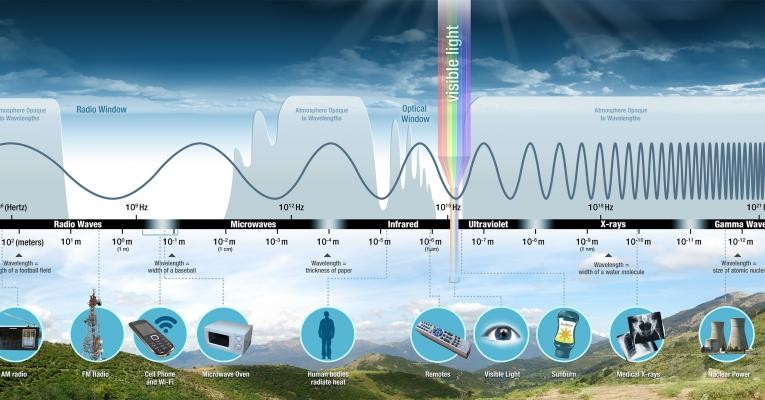
- Overview
Radio basics involve using a carrier wave (a radio wave) to carry information by modifying its properties (amplitude, frequency, phase) through modulation (like AM or FM).
The signal's bandwidth is the range of frequencies it occupies, determining how much info it holds, while amplitude measures the wave's strength (volts), representing the signal's power or height in the wave cycle.
1. Key Concepts:
- Amplitude: The strength or height of a radio wave, measured in volts, reflecting the signal's power.
- Analog: Information (like voice) is directly mapped to the carrier wave's varying property (amplitude, frequency, or phase).
- Bandwidth: The total frequency range (in Hertz) a signal uses, including sidebands, determined by the complexity of the information.
- Carrier Wave: An unmodulated radio wave that acts as a vehicle; information is "impressed" onto it.
- Modulation: The process of encoding information onto the carrier wave (e.g., AM changes amplitude, FM changes frequency).
- Digital: Converts analog signals (voice, video) into binary (1s and 0s) for transmission, contrasting with analog's continuous waves.
2. How it Works (Simplified):
- Information Creation: Sound waves (voice) are converted into electrical signals (analog) or sampled and converted to digital data.
- Modulation: This information modifies a carrier wave (e.g., a radio station's frequency).
- Transmission: The modulated signal travels through the air as radio waves.
- Reception: A receiver tunes to the carrier frequency, separates the original information from the carrier (demodulation), and converts it back to sound or video.
[More to come ...]
