
Wireless Signals and Signal Processing
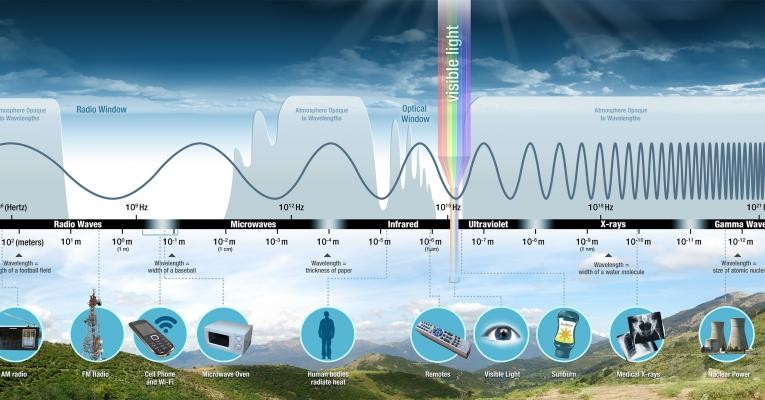
- (EM Energy - NASA)
Signal Processing: The Science Behind Our Digital Life
- Overview
Signals and signal processing are fundamental to addressing the critical challenges facing 5G and beyond networks. These challenges, including managing massive traffic volumes, excessive signaling loads, interference, and energy consumption, necessitate advanced signal processing techniques for efficient and reliable wireless communication.
Signal processing is the core enabling technology that transforms the physical limitations of the wireless spectrum into robust communication links capable of meeting stringent 5G requirements. It provides the algorithmic foundation for managing the complexity and scale of modern networks.
- Basics of Signals and Signal Processing
Wireless signals are electromagnetic waves carrying information (data, voice, video) through the air, while signal processing is the essential technology that manipulates these signals to extract meaning, remove noise, compress data, and enable reliable communication, forming the backbone of Wi-Fi, mobile networks (5G and beyond), Bluetooth, and GPS by converting analog waves into digital data and back.
Key processes include filtering noise, modulating/demodulating information onto carriers (like AM/FM), encoding/decoding, down-converting frequencies, and using machine learning for smart adjustments, making devices work together seamlessly.
In essence, wireless signals are the medium, while signal processing is the intelligence that makes wireless communication and sensing possible and useful.
1. Key Concepts:
- Electromagnetic Spectrum: Wireless signals (radio, microwave, infrared) travel as waves of energy at specific frequencies (Hz).
- Baseband vs. Passband: Baseband signals are around zero frequency (raw data); passband signals are modulated (shifted) to a carrier frequency for transmission.
- Analog-to-Digital Conversion (ADC): Converts continuous analog signals into discrete digital bits (0s and 1s) for processing.
- Modulation/Demodulation: Encoding data onto a carrier wave (modulation) and extracting it at the receiver (demodulation).
2. How Signal Processing Works in Wireless Systems:
- Reception: An antenna captures the weak, noisy wireless signal.
- Amplification & Down-conversion: The signal is boosted and its frequency lowered to baseband.
- Filtering: Unwanted noise and interference are removed.
- Digitization (ADC): Analog signal becomes digital data.
- Decoding: Information bits are extracted from the modulated signal.
- Digital Signal Processing (DSP): Algorithms clean, compress, and interpret the data.
- Machine Learning: Adaptive techniques adjust parameters for changing conditions (e.g., fluctuating signal strength).
3. Applications:
- Smartphones & Wi-Fi: Managing multiple devices, decoding data.
- Wearables: Tracking fitness, heart rate, location data.
- Radar & Sensing: Extracting information from RF signals.
- 5G/6G Networks: Enabling higher data rates and new mobile services.
4. Types of Signal Processing:
- Digital Signal Processing (DSP): Works with discrete digital data (algorithms, math, programming).
- Adaptive Signal Processing: Systems adjust to changing signal environments.
- Communications (CSPN): Focuses on efficient data transmission and reception.
- Advanced Signal Processing Helps 5G and Beyond Achieve Speed Targets
Advanced signal processing (DSP) is crucial for 5G and beyond, using techniques like Massive MIMO, beamforming, AI/ML, and efficient digital structures to boost data rates, reduce latency, and improve efficiency by intelligently managing signals, adapting to user needs, and coordinating transmitters, paving the way for higher speeds and capabilities in future networks like 6G. DSP enables better use of spectrum, manages complex multi-user communication, and optimizes radio-over-fiber links for demanding applications.
1. Key Signal Processing Techniques for Speed & Capacity:
- Massive MIMO (Multiple-Input Multiple-Output) & Beamforming: Using large antenna arrays to focus signals precisely on users, increasing gain and flexibility, and enabling more simultaneous data streams.
- AI/ML Integration: Using machine learning for predictive channel estimation and network optimization, reducing overhead and adapting to changing wireless conditions.
- Advanced Beamforming Receivers: Controlling signal sampling and combining signals from multiple paths for better reception.
- Efficient Digital Transmitters: Supporting multiple broadcast channels from a single antenna.
- Coordinated Multipoint (CoMP): Allowing distributed transmitters to work together for improved coverage and signal quality.
- Low Latency, Low Loss, Scalable Throughput (L4S): Improving network responsiveness, especially for upload performance, even when networks are busy, notes CCS Insight.
2. How it Drives Performance:
- Higher Throughput: Better signal management means more data can be sent and received reliably.
- Lower Latency: Optimized signal paths and faster processing reduce delays, critical for applications like autonomous driving.
- Increased Capacity: More efficient spectrum use and better handling of simultaneous users.
- Enhanced Quality of Service: Adapting to user mobility and coordinating transmitters ensures consistent performance.
3. Beyond 5G (B5G/6G):
- DSP continues to evolve, incorporating techniques like non-orthogonal multiple access, hybrid satellite-terrestrial relays, and new frequency bands (terahertz) for speeds beyond 5G's capabilities, targeting terabit-per-second speeds.
- DSP-enhanced radio-over-fiber (RoF) systems are vital for seamless wired-wireless convergence, managing challenges in capacity and latency for future access networks.
- Artificial Intelligence (AI) in Signals and Signal Processing
Artificial intelligence (AI) revolutionizes signal processing by enabling machines to learn complex patterns, automate feature extraction, and adapt in real-time, surpassing traditional methods in noise reduction, anomaly detection, and classification for applications like speech recognition, medical imaging, and communications.
Machine learning (ML) models identify subtle features in noisy data, leading to improved accuracy and autonomous decision-making, especially with deep learning and generative AI for tasks from electronic warfare to predictive maintenance.
1. Key Ways AI Enhances Signal Processing:
- Noise Reduction & Enhancement: AI models learn noise characteristics and filter them adaptively, significantly improving signal clarity beyond fixed algorithms.
- Pattern Recognition & Feature Extraction: AI automatically discovers hidden patterns and features in raw data, crucial for complex tasks like classifying signals or identifying anomalies.
- Anomaly Detection: Rapidly spots deviations from normal signal behavior, enabling early warnings for equipment failure or security threats.
- Adaptive Processing: Makes signal processing parameters dynamic and versatile, adjusting to changing conditions.
- Real-Time Decision Making: Facilitates faster, automated decisions based on continuous signal analysis.
- Generative AI: Creates synthetic data for training and enhances signal restoration, pushing boundaries in data-intensive scenarios.
2. Applications:
- Electronic Warfare (EW): Rapidly discovering, characterizing, and countering adversary signals.
- Industrial IoT: Predictive maintenance and digital twins by analyzing sensor data.
- Healthcare: Analyzing biomedical signals (EEG, ECG) for diagnostics.
- Communications: Boosting efficiency and robustness in wireless systems.
- Audio/Speech: Improving speech recognition and generating realistic audio.
3. How it Works:
Traditional signal processing uses programmed rules, while AI, particularly deep learning (neural networks), learns from vast datasets. An AI model might process a signal through layers, extract relevant features, and classify it (e.g., identifying a specific voice or type of interference).
- Quantum Computing in Future Signals and Signal Processing
Quantum computing will revolutionize signals and signal processing (QSP) by enabling ultra-fast, complex analysis for applications like 6G/7G networks, AI, and IoT, using quantum phenomena (superposition, entanglement) for enhanced detection, parameter estimation, and secure communication (QKD).
Future systems will leverage QSP to design more efficient algorithms, create unbreakable encryption, optimize resource allocation (beamforming), and achieve real-time control, moving beyond classical physics to handle massive data streams and complex network demands.
In essence, quantum computing offers a paradigm shift, moving signal processing from merely analyzing existing signals to actively shaping and understanding information at a fundamental quantum level.
1. Key Impacts on Signals & Signal Processing:
- Ultra-Fast Processing: Quantum algorithms can analyze vast datasets in real-time, crucial for complex wireless communication (5G/6G/7G) and autonomous systems.
- Enhanced AI/ML: Quantum signal processing accelerates machine learning, enabling faster learning and adaptation in complex signal environments.
- Secure Communications: While quantum computers threaten current encryption (Harvest Now, Decrypt Later), they also enable quantum-resistant cryptography (PQC) and Quantum Key Distribution (QKD) for theoretically unbreakable security, notes Signal Messenger and Substack.
- Network Optimization: QSP aids in optimal cell placement, self-healing networks, advanced beamforming, and interference mitigation, improving network efficiency, as discussed in IEEE.
- New Algorithm Design: QSP provides a unified mathematical framework (mapping phases to polynomials) to design new filters and processing techniques for various tasks like parameter estimation and covariance shaping, says DSpace@MIT and eScholarship.
2. Emerging Applications:
Wireless Communications: Real-time traffic control, enhanced throughput, and improved signal detection in crowded spectrums.
Signal Intelligence (SIGINT): Faster decryption and analysis of intercepted messages, while simultaneously securing sensitive data.
Internet of Things (IoT): Processing massive data streams from interconnected devices more efficiently.
3. Challenges & Progress:
Hardware Maturity: Building fault-tolerant quantum computers remains a challenge, though breakthroughs like Google's Willow chip are making progress in error correction.
Integration: Engineers are working on methods to integrate quantum signals with existing classical internet protocols, making them more practical.
[More to come ...]
